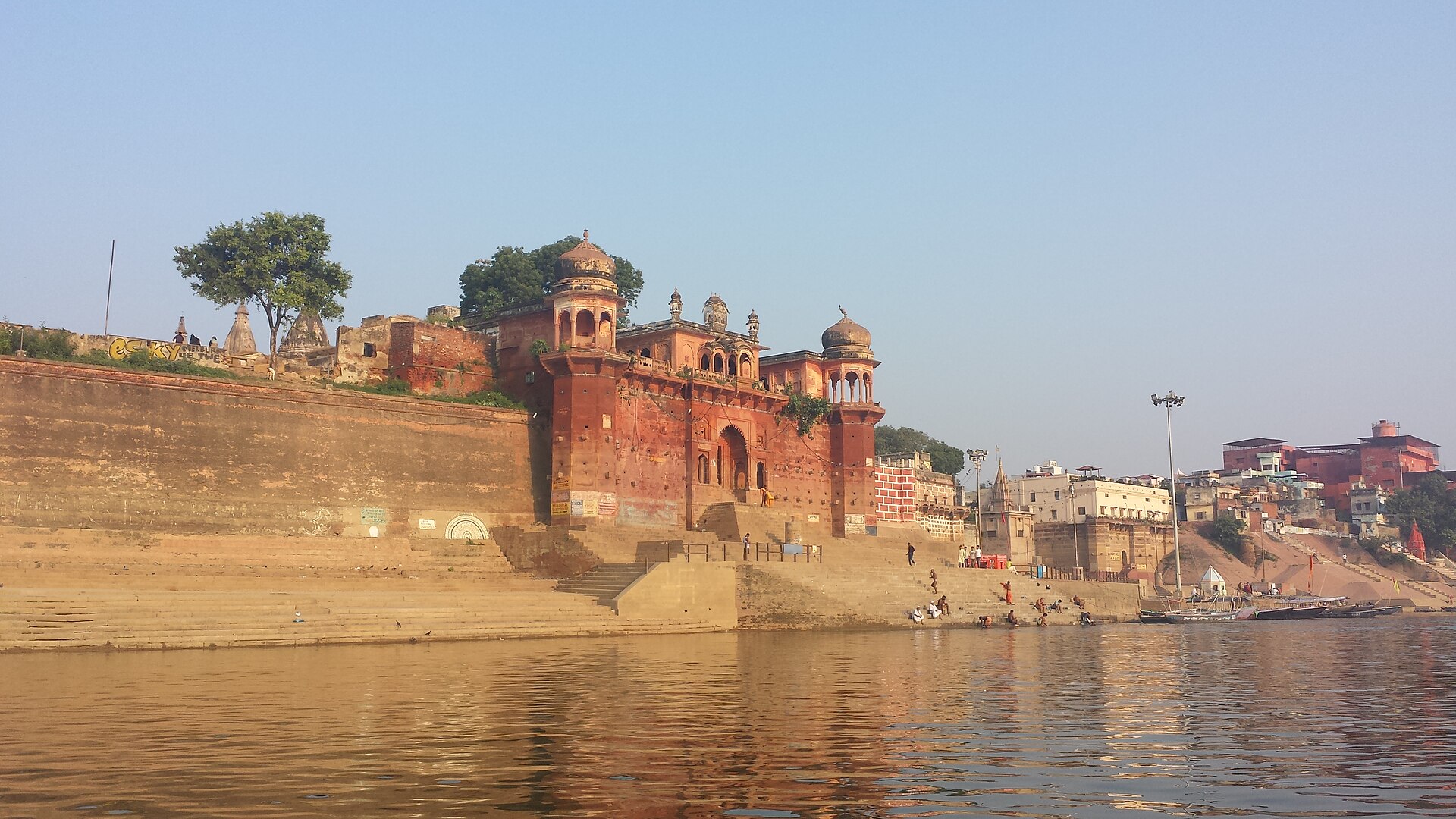
Dashashwamedh has the evening aarti and Assi has the morning one, so between them they hold most of the river’s visitors. The other ghats — there are more than eighty — are where the city actually lives: washing, bathing, wrestling, studying, and simply sitting by the water.
The other ghats are where the city actually lives.
Darbhanga and Munshi Ghats
Just north of Dashashwamedh, a tall sandstone palace rises straight out of the steps. It was built for the royal family of Darbhanga in Bihar and is one of the most photographed façades on the river, yet few people stop to look closely at it from below.
Chet Singh Ghat
Fortified walls give this ghat the look of a small castle. In 1781 it was the scene of a clash between the soldiers of Raja Chet Singh of Benares and the troops of Warren Hastings, who escaped across the river. Today it is quiet and wide, and a good place to sit.
Kedar Ghat
Its steps are painted in red and white bands, and the Kedareshwar temple above is especially dear to pilgrims from the south of India. Mornings here are busy with bathers but rarely with tourists.
Panchganga and Adi Keshava Ghats
Tradition holds that five rivers meet at Panchganga Ghat, and in the month of Kartik it is hung with lamps raised on tall bamboo poles. Further north, where the Varuna joins the Ganga, Adi Keshava Ghat and its Vishnu temple mark the old northern edge of the sacred city. Boats seldom come this far, which is the point.
The ghats are joined by steps rather than a level path, and walking the whole river front is hard going. A boat at first light, with the boatman asked to go north rather than south, shows all of these in an hour without a single stair.